


HDPE
HIGH DENSITY POLYETHYLENE

CHEMICAL RESISTANCE
Ideally suited for applications involving frequent exposure to aggressive substances, this material offers excellent resistance to a wide range of aqueous chemical solutions, including acids, alcohols and bases.

MOISTURE ABSORPTION
The low moisture absorption helps preserve both the mechanical and chemical properties of the material, even in humid environments or in contact with liquids, ensuring long-term dimensional stability.

IMPACT RESISTANCE
Thanks to its high toughness, HDPE provides outstanding impact resistance, ensuring reliable performance under heavy loads or mechanical stress conditions.

PROCESSABILITY
With its excellent processability, HDPE allows great design flexibility, enabling the production of customized components tailored to specific application requirements in chemical process environments.
When integrated into polymer matrices such as HDPE, carbon fibre acts as a reinforcement that significantly enhances the overall performance of the material.

ELECTRICAL CONDUCTIVITY
Carbon fibre reinforcement reduces electrical resistivity, imparting dissipative properties and improving the material’s ability to conduct electrical charges compared to the unfilled polymer.

STIFFNESS-TO-WEIGHT RATIO
The addition of carbon fibre increases the material’s stiffness while maintaining a low weight, enabling the design of strong and efficient components for weight-sensitive applications.

RESISTANCE IN HARSH ENVIRONMENTS
Under exposure to pressure and corrosive agents, carbon fibre reinforcement improves material performance by enhancing long-term durability in demanding chemical environments.

MECHANICAL STRENGTH
Carbon fibre reinforcement increases the material’s ability to withstand high loads and stresses, improving its structural stability and ensuring consistent mechanical performance over time.
THE MATERIALS
PERFORMANCE COMPARISON
STIFFNESS
Carbon fibre–reinforced HDPE exhibits a significantly higher tensile strength compared to unfilled HDPE, resulting in a marked increase in both strength and stiffness of the composite.
In the chemical processing industry, carbon fibre–reinforced HDPE is ideal for applications requiring enhanced robustness, such as high-pressure piping or structural components subjected to heavy loads, offering superior mechanical performance beyond the limits of standard HDPE.
Tensile Strength (Mpa)
XECARB® 18-C20
HDPE
CHEMICAL RESISTANCE AND CARBON FIBRE REINFORCEMENT
High-density polyethylene (HDPE) is a semi-crystalline thermoplastic extensively used in chemical process applications due to its exceptional chemical inertness. The HDPE matrix is insoluble in most organic solvents at room temperature and exhibits excellent resistance to acids, alkalis and a wide range of corrosive agents.
Incorporation of carbon fibre reinforcement does not affect the intrinsic chemical stability of HDPE; the composite maintains full compatibility with aggressive fluids and environments typically encountered in chemical processing and fluid-handling systems.
The fibre reinforcement significantly enhances the mechanical performance of the material, increasing modulus, tensile and flexural strength and overall toughness, while preserving its lightweight nature.
This combination of mechanical efficiency, dimensional stability and unaltered chemical resistance makes carbon fibre–reinforced HDPE a strategic solution for demanding process equipment such as storage tanks, high-pressure piping, pumps and valves operating under corrosive and challenging conditions.
APPLICATIONS
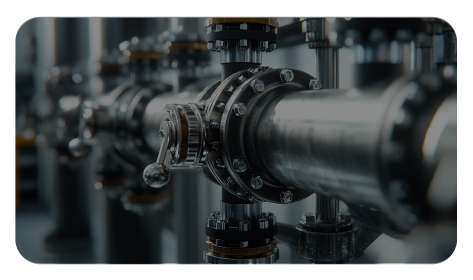
Pipes and Infrastructure
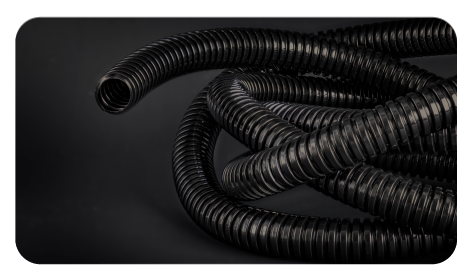
Insulation and Protection